
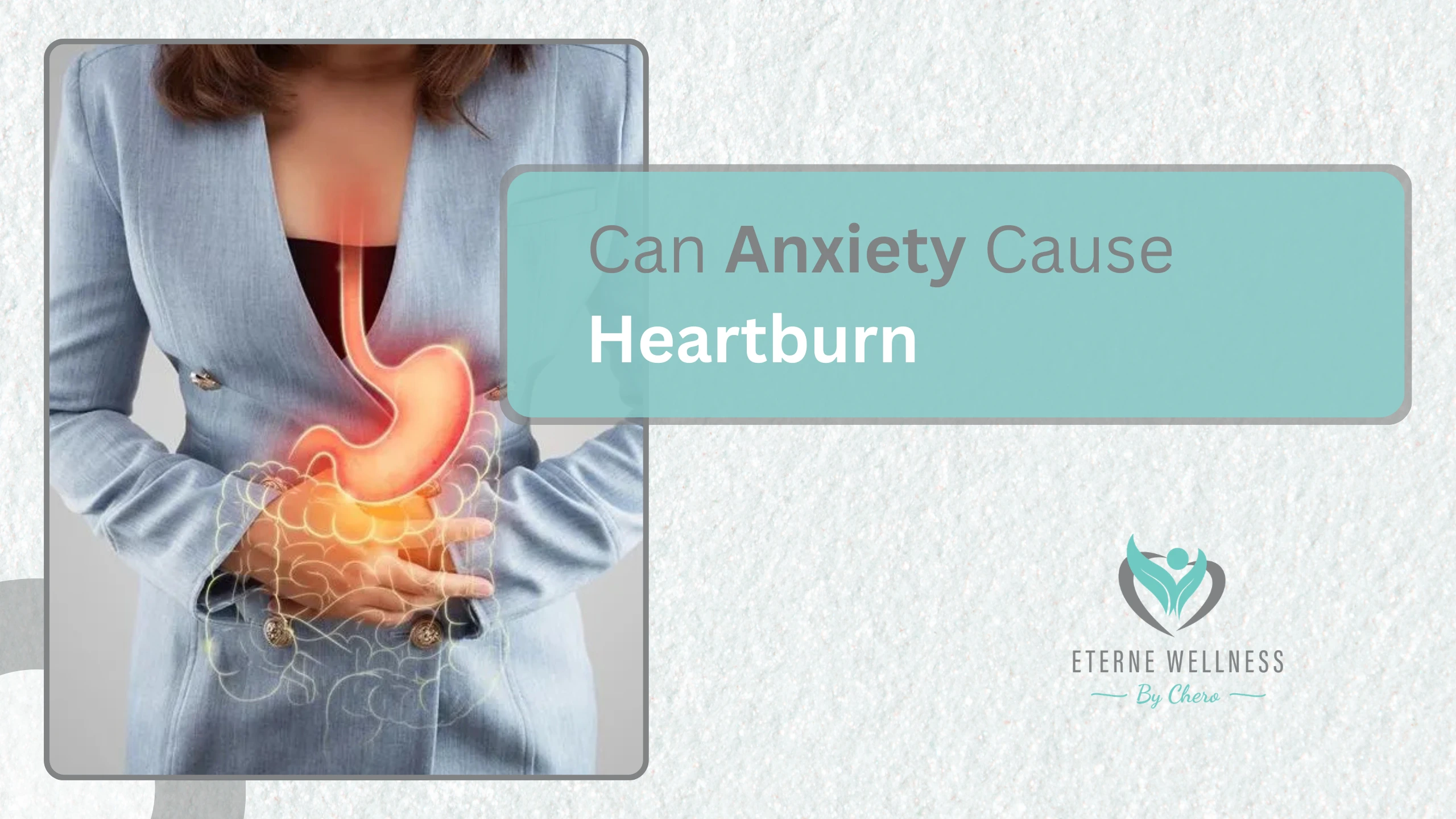
Anxiety does bring about heartburn. Such an answer is a surprise to many people, primarily because heartburn is so physical.
The burning, the soreness of the throat, the pains of the chest. It is as though it were a stomach issue.
But to most individuals, the stomach is the place where the anxiety gets to.
This may be the missing link in your case; you have been managing both of these conditions, and the antacids have only gotten you so far.
What Heartburn Is
Heartburn occurs when the stomach acid flows backward and enters the esophagus.
The esophagus is not constructed to receive acid. When it comes into contact with its lining, you get that same burning feeling, typically in the back of the breastbone or in the throat.
That is the whole mechanism.
What it is not, however, despite the name, is a heart problem.
It does not have anything to do with your heart. Its name is so because of its location.
The common symptoms that are described by people:
- Burning in the chest, often worse after eating or when lying down
- A sour or bitter taste rising into the throat or mouth
- A sense of pressure or fullness in the upper chest
- Burping or bloating more than usual
- A feeling that food is sitting too high, not moving down properly
When the occurrence is persistent, the physicians refer to it as GERD, which is an initialism of gastroesophageal reflux disease.
And when it continues to repeat even on the occasions when you are eating thoughtfully then this is when it is worth considering what other factors could be motivating it.
The Gut and the Brain Are In Constant Communication
This is one of the things that most people find out once it is too late to do anything about it: the gut has its own nervous system.
It has about 100 million nerve cells, and it is to a great extent self-governing, yet it remains always in contact or in connection with the brain via the so-called gut-brain axis.
This is not a loose concept. It is a documented and two- way communication system. The gut is also affected by the brain and vice versa.
Every person who has just once felt sick before a stressful event, or just lost their appetite during a hard time in life, has been able to personally experience this.
When stress kicks in due to anxiety, the body moves into a high alert position.
Digestion is not a priority in that state. Resources get pulled away from it:
- Blood flow moves away from the stomach and intestines toward the muscles
- Digestion slows down
- The lining of the stomach becomes more reactive
- Muscle tension increases throughout the digestive tract
- Acid production goes up
For someone dealing with persistent anxiety, these effects are not occasional.
They are consistent. And consistent acid overproduction with a tense, reactive gut is exactly the setup for chronic heartburn.
The Specific Ways Anxiety Triggers Heartburn
There is more than one pathway here, which is partly why anxiety-related heartburn tends to be stubborn.
The acid problem
Cortisol, the main stress hormone your body releases during anxiety, stimulates acid production in the stomach.
More acid means more opportunity for it to push upward into the esophagus. If your anxiety is ongoing, so is the cortisol output, and so is the acid.
The valve problem
Between the esophagus and the stomach sits a small ring of muscle called the lower esophageal sphincter.
Its job is to act as a one-way gate: food goes down, acid stays down.
Chronic stress interferes with how well this sphincter works. Under sustained pressure, it relaxes when it should not, and acid gets through.
The breathing problem
Anxious people breathe differently.
- Shallow, fast, chest-centered breathing raises pressure inside the abdominal cavity.
- That pressure physically pushes stomach contents upward.
- Slow belly breathing, the kind that actually activates your parasympathetic nervous system, keeps that pressure stable.
Anxiety breaks that pattern.
The pain sensitivity problem
Anxiety lowers your pain threshold across the board.
In the gut specifically, this is called visceral hypersensitivity! It’s well documented in people with anxiety and gastrointestinal conditions.
What it means practically – a small amount of acid reflux that might barely register on a calm day can feel intense and alarming when your nervous system is already running hot.
The behavior problem
Anxiety also shapes what you do without you always noticing it.
Eating fast because you are distracted or rushing. More coffee to get through the day. Alcohol to unwind at night. Lying on the couch when you feel overwhelmed.
Skipping meals and then eating too much at once. These are all understandable responses to stress. They also happen to be a reliable list of heartburn risk factors.
How to Tell If Anxiety Is the Driver
Not every case of heartburn comes from anxiety. But certain patterns make the connection fairly clear.
Your symptoms flare during stressful periods. Not randomly, not after certain foods, but reliably when life is harder.
- A difficult stretch at work
- A conflict is unresolved
- A period of worry about health, money, or family
Antacids help temporarily but do not fix it. They manage the acid, not whatever is producing it. If the problem keeps coming back, the root has not been addressed.
The heartburn shows up alongside other anxiety symptoms.
- A racing heart
- Shallow breathing
- Tightness in the chest
- A background sense of dread
Heartburn that keeps that company is rarely a coincidence.
It gets worse at night. Anxiety tends to peak in the quiet hours when there is nothing left to focus on but the worry itself. Lying flat also makes reflux more likely physically. At night, both factors combine.
It started during or after a difficult period in your life. Sometimes people can trace their heartburn directly to a hard season: a loss, a health scare, a major transition. If your lines up with something like that, anxiety is likely part of the story.
| A note on chest symptoms. Heartburn, anxiety, and cardiac events can all produce chest discomfort. If your symptoms are sudden, severe, or come with shortness of breath, arm or jaw pain, sweating, or a feeling that something is seriously wrong, do not try to figure it out online. Go to the emergency room. These symptoms need to be evaluated by a doctor. |
Why Treating Only the Stomach Falls Short
An antacid reduces the acid in your stomach right now. It does not lower your cortisol. It does not fix the lower esophageal sphincter.
It does not calm the nervous system or change the patterns that keep generating the problem.
This is not a criticism of antacids.
For occasional heartburn, they are perfectly reasonable. But if heartburn is recurring and tracks closely with your anxiety and stress, you are managing a symptom while leaving the cause in place.
There is also a loop that develops. Anxiety causes heartburn. The heartburn causes more worry, especially for people who tend toward health anxiety.
That worry feeds more anxiety. More anxiety means more acid. The burning gets worse, the fear gets louder, and the cycle holds.
Breaking out of it requires actually addressing the anxiety, not just what it produces in the stomach.
What Can Actually Help
Modifications that are beneficial to digestion and anxiety
Certain practices lessen the two issues simultaneously, and this is what makes them worth developing as part of the everyday routine:
- Smaller and slower meals exert less stress on the stomach and the sphincter holding the acid.
- Reducing caffeine and alcohol eliminates two substances which make people anxious and irritate the stomach walls.
- Having meals two to three hours before sleep allows time for the stomach to empty before sleep.
- Exercise is one of the most frequently used and effective means of reducing anxiety and improving the digestive system.
- Slow and diaphragmatic breathing stimulates the rest-and-digest mode of the nervous system and reduces abdominal pressure simultaneously.
Addressing the anxiety itself
Managing symptoms is useful. It is better to reduce the anxiety that produces those symptoms.
Cognitive Behavioral Therapy is useful.
It is based on assisting you to recognize and disrupt the thought processes that perpetuate the state of anxiety in you, as well as the health-based spirals, which heartburn may induce.
A mindfulness-based stress reduction approach trains the nervous system so that it eventually responds to stressors with less escalation.
This is a cumulative impact that is likely to be persistent.
The secret of sleep is worth giving priority to. Poor sleep and anxiety are well-documented to reinforce one another.
Regular, sufficient sleep is associated with lowering the level of baseline anxiety in a manner that is difficult to achieve using alternative methods.
When anxiety needs more than lifestyle changes
Some individuals may not respond to lifestyle changes and therapy.
This is particularly in cases where anxiety has existed over a period of years, where it is severe or when it is related to depression, PTSD or other major past trauma.
Anxiety is a medical issue that is worthy of medical intervention in such cases.
How Eterne Wellness Approaches This
Treatment at Eterne Wellness in Las Vegas begins with finding out what is really happening to a certain patient.
Some alternatives are much more radical when it comes to patients whose anxiety has not been successfully addressed using conventional methods.
Transcranial Magnetic Stimulation
TMS involves the administration of localized magnetic impulses to brain regions that control mood and other anxiety-inducing elements.
FDA-approved, non-invasive, anddoes not need medication or recovery.
The patients who have exhausted all possible medication options without any tangible results usually achieve the effect of TMS, where other treatment options have failed.
Ketamine Therapy
Ketamine operates in an alternative mechanism to antidepressants and anti-anxiety drugs.
It is an agent that works on NMDA receptors within the brain, and it is able to give meaningful relief within a relatively short period of time.
It is commonly a real turning point for patients who have exhausted the alternative routes to no avail.
Medication Management
In case medication is included in the strategy, the staff at Eterne Wellness offers meticulous continuous monitoring.
This involves checking on your levels of response, making adjustments where all is not going well, and looking at the entire picture of your health and not only the psychiatric part.
IV Therapy
Constant worry wears the body out in the long run.
Stress takes a toll on the dietary nutrients that are needed to regulate brain functions and their availability becomes depleted at an even faster rate.
IV nutrient therapy assists in regaining that balance, helping the body to respond to treatment and sustain improvement.
Get Support
To learn more about how we can help, book a consultation at Eterne Wellness today.
