
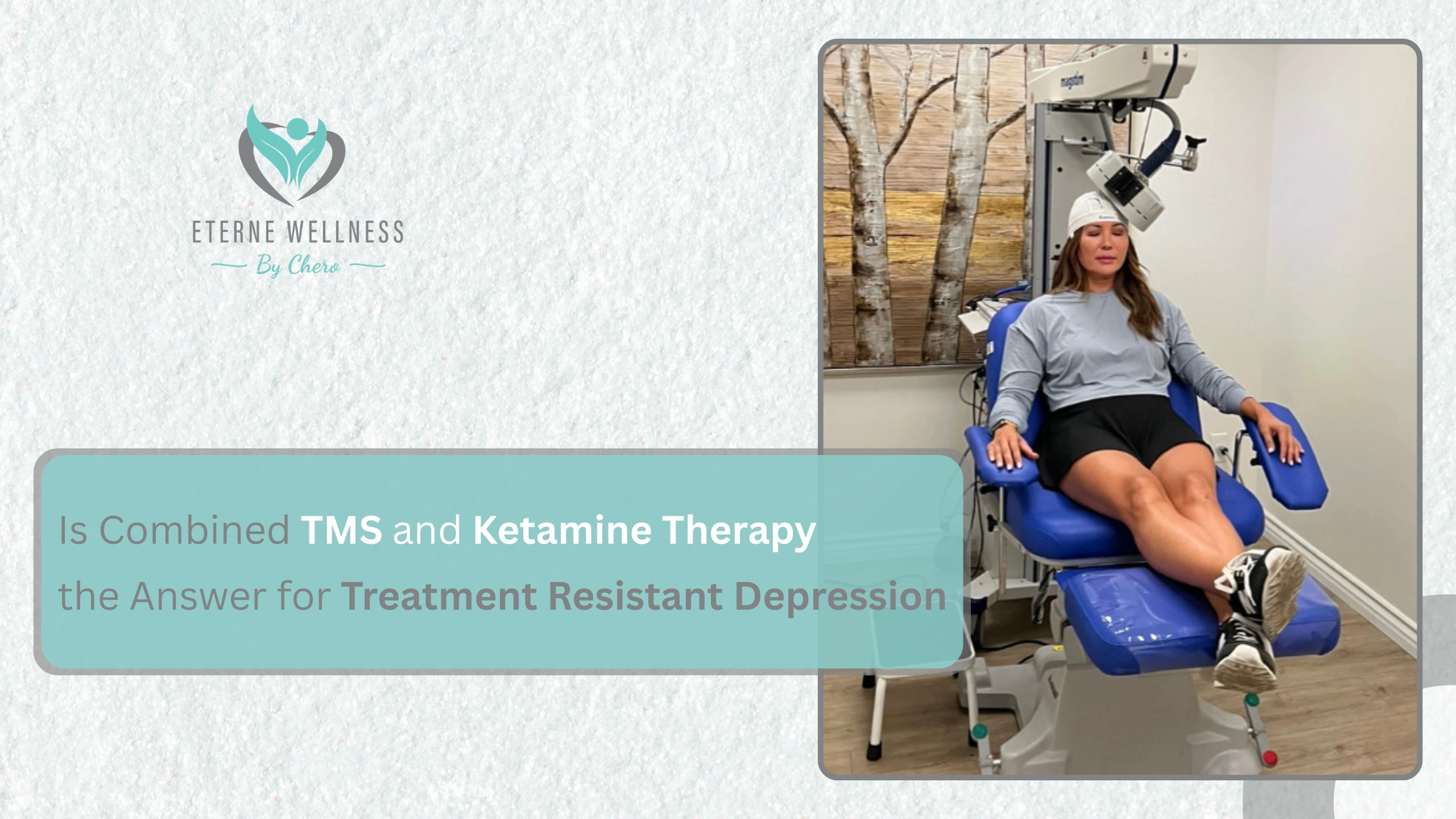
Given the effort involved in finding relief from depression after failing to respond to conventional therapeutic methods, it is a highly unsettling experience.
You have now exhausted the medication route, and perhaps even the therapy route, but you are still in that same dark numbness.
We know how tiresome it is, and we know how vexing it is.
Treatment-Resistant Depression occurs in about 30 percent of patients with Major Depressive Disorder.
The combination therapy of two potent individual therapies, Transcranial Magnetic Stimulation (TMS) and Ketamine gives new hope.
Many patients weigh TMS vs ketamine as separate options, but combining both may offer something neither can achieve alone.
Defining Treatment-Resistant Depression
There is a misconception about Treatment-Resistant Depression. It is not about patients giving up.
It is a legitimate medical condition that describes patients who have not responded to two or more different antidepressants.
Each antidepressant, however, must have been prescribed at an adequate dosage for a clinically appropriate duration.
These individuals comprise one-third of the depressed population and are at greater risk for suicidal ideation, a greater number of hospital visits, and severely restricted daily function.
How TMS Works
TMS provides stimulation to the brain’s dorsolateral prefrontal cortex (DLPFC) to modulate the brain’s mood-regulating systems. It utilizes electromagnetic fields to stimulate the brain.
It was approved by the FDA for clinical use to treat major depression in 2008, and it has several different benefits, including:
- It is a non-invasive and non-drug treatment
- It has minimal side effects (typical side effects are mild discomfort on the scalp)
- It is an outpatient procedure; the treatment duration is between 20 and 40 minutes
- It has a proven treatment-resistant major depression efficacy of between 30 to 90%
TMS therapy effectiveness and overall TMS treatment effectiveness are well documented, but the only identified limitation is that it requires multiple treatment sessions over several weeks to identify clinical improvements in the patient’s condition.
A common question is how many TMS sessions are needed – and how effective is TMS for depression long-term, which is why ongoing research into combination approaches is so valuable.
Related – Can Accelerated TMS Beat Depression in Just 5 Days?
How Ketamine Works
Ketamine has long been used in the form of an anesthetic. When it is used in lower dosages, it is a fast-acting antidepressant.
Unlike the conventional antidepressant drugs, which take some time to benefit the patient when used chronically, treating depression with ketamine can be of benefit to the patient within a very short period.
This is one of the most significant differences when weighing ketamine vs traditional antidepressants.
This is achieved by the physician blocking the general classification of receptors termed NMDA receptors, as well as facilitating the formation of new neural connections, termed neuroplasticity.
So what are the benefits of ketamine therapy? They include:
Rapid onset benefits (within a few hours)
- Effectiveness for suicidal ideation
- Works via the glutamate pathways as opposed to traditional antidepressants
The limitation of ketamine use is that the short-term benefits can only be achieved when ketamine is used by itself.
This will be a strong justification for the need to use ketamine in combination with other medications to sustain the benefits of treatment.
For those seeking ketamine therapy benefits in Las Vegas, NV, combining it with TMS can actually provide long-lasting relief.
The Power of Combination
The combination of TMS and ketamine works because each type of therapy works on different neuropsychological functions of depression and utilizes different neurobiological pathways.
This includes emerging protocols using TMS and Spravato together.
What Research Shows
New research on TMS with ketamine treatment, showing promising results, includes:
- Prolonged improvement. Some studies suggest symptom reduction that lasts up to two years
- Quick and long-lasting. Ketamine gives immediate relief, TMS offers lasting improvement.
- More tolerable. Patients who received ketamine coverage were able to tolerate higher TMS intensities.
A detailed systematic review published in Cureus examined studies of TMS and ketamine combination treatment and found that all treatment-resistant depression patients, every one of them, had substantial and sustained improvement in their depression.
Clinical scores showed significant improvement with long-lasting results, and even complete symptom remission one year after treatment in some patients.
How It Can Work in Practice
While treatment protocols differ, a few patterns include:
- Concurrent: Both treatments in one TMS session (e.g., TMS for 30 minutes and a 20-minute ketamine infusion)
- Sequential: Either ketamine first for acute relief and then TMS, or the reverse, where TMS is first and ketamine is added for acute relief
Typical Frequency:
- Ketamine: Every 2 weeks for 3-4 weeks and then maintenance
- TMS: Every day, 5 times for 4-6 weeks
Who Benefits Most?
Combined therapy seems to benefit:
- Individuals with treatment-resistant depression under multiple antidepressants
- Patients that experience severe symptoms, particularly with suicidal ideation
- Patients whose response to one treatment is partial and in need of further assistance
- Patients with depression, anxiety, or PTSD
Important Considerations
Both treatments have records of safety independently.
TMS side effects are mild and include headaches and scalp discomfort.
Ketamine may cause dissociation, elevated blood pressure, and headache during infusions.
There are no studies to support that combined treatment poses additional risks. The following factors must be taken into consideration:
- Cost – Both therapies can be costly, depending on the level of insurance coverage.
- Commitment – Both therapies require multiple visits to the clinic over a span of a few weeks.
- Contraindications – There are certain conditions that could contraindicate one or both of the therapies.
- New Techniques – Newer therapies and techniques are coming to light.
What To Expect
Most patients report feeling an improvement in their mood just a few hours or a couple of days after the first dose of the ketamine.
The positive effects of the TMS will continue to be felt and will progressively improve the patient’s mood over the course of the following weeks.
The Bottom Line
Everybody is different! There is emerging evidence that it is probably the most optimal possible solution for most people with treatment-resistant depression who are seeking the right treatment.
Some people, for example, may experience complete remission from depression. For others, the response may be only partial, or in the worst case, the depression may remain unchanged.
For depression that has not improved despite multiple previous treatment attempts, the combination of TMS and ketamine therapy offers innovative and effective options.
Get Treatment
At Eterne Wellness, we understand the journey that comes with treatment-resistant depression. We support your persistence in the search for answers when standard treatment protocols have failed.
We excel in both TMS and ketamine treatments, and we have providers who have mastered the art of combining both for even greater efficacy.
We take an individualized, proven approach in trying to achieve your treatment expectations.
Would you like to find out if combined TMS and ketamine therapy is right for you?
Get in touch with Eterne Wellness today.
Phone: (725) 895-9300
Email: contact@eternewellness.com
Address: 2820 W Charleston Blvd. #38, Las Vegas, NV 89102
FAQ
How long does combined therapy take to show results?
Unlike other therapies that are more effective in the long run, combining ketamine therapy and TMS therapy is ideal.
Within several hours to days of beginning treatment, you will notice improvements from the ketamine, and several weeks after, you will notice improvements from the TMS therapy.
This is ideal for rapid improvement and long-lasting improvement.
Is combined therapy riskier?
Recent studies indicate that combining TMS and ketamine therapy has no extra risks than if each were done independently.
Both have well-established safety records if done by trained and qualified physicians.
Is combined therapy covered by insurance?
This depends on the insurance provider and the specific plan.
To check your specific coverage, please talk to your insurance provider and to our office.
What if I’ve previously had TMS and or ketamine therapy done individually?
You may still benefit from it.
